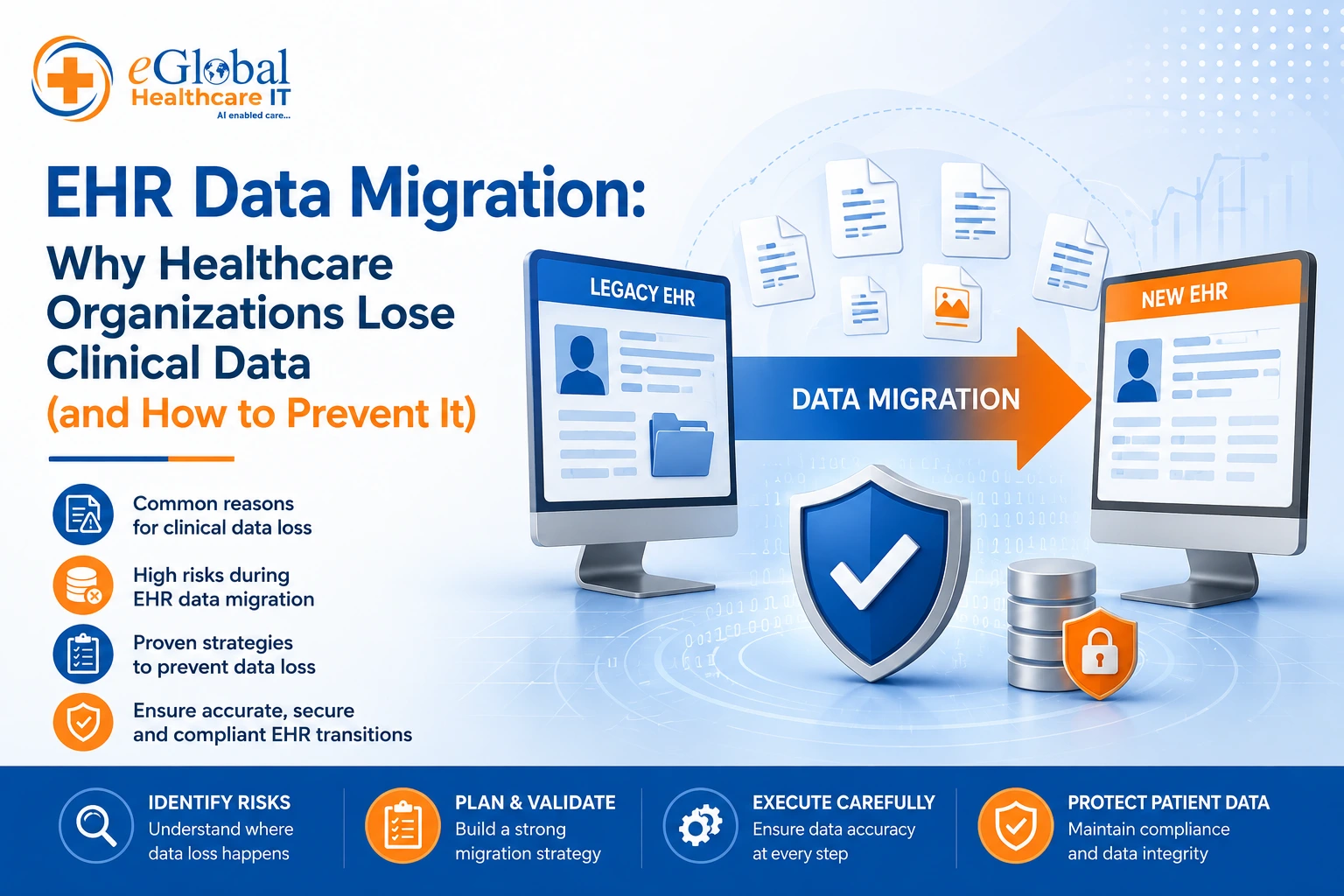
Direct entry with a problem statement — hospitals migrating EHRs consistently underestimate data migration complexity. Cite the fact that clinical data errors post-migration are a patient safety issue, not just an IT issue. Position eGlobal Healthcare IT as a team that has executed structured data migrations into Cerner Millennium and Epic.
What Makes Healthcare Data Migration Different from Standard IT Data Migration?
Clinical Data Has Patient Safety Implications, Not Just Business Continuity Implications
- Structured vs unstructured data (notes, scans, orders)
- Legacy system formats: HL7 v2, proprietary EMR schemas, flat files, scanned documents
- Data that cannot be auto-migrated and requires manual review/clinical sign-off
The Volume and Variety of Healthcare Data Types
- Structured vs unstructured data (notes, scans, orders)
- Legacy system formats: HL7 v2, proprietary EMR schemas, flat files, scanned documents
- Data that cannot be auto-migrated and requires manual review/clinical sign-off
What Are the Most Common EHR Data Migration Failures?
Incomplete Data Mapping Between Legacy and Target EHR
- Source system data fields do not have a direct equivalent in the target EHR
- Drug code mapping failures (NDC to RxNorm, local drug codes to standard terminologies)
- Diagnosis code version mismatches (ICD-9 to ICD-10)
Incomplete Data Mapping Between Legacy and Target EHR
- Migrating dirty data produces dirty results — garbage in, garbage out
- Common legacy EMR data quality issues: duplicate patients, inconsistent date formats, orphaned records
Incomplete Data Mapping Between Legacy and Target EHR
Migration Risk | Root Cause | Prevention |
Missing medication histories | Incomplete mapping | Pre-migration data audit |
Duplicate patient records | No deduplication logic | MPI reconciliation before cutover |
Lost clinical notes | Unstructured data not scoped | Define scope; migrate to document repository |
Failed allergy data | Code system mismatch | Terminology mapping validation |
Broken lab references | Interface not rebuilt | LIS integration testing in parallel |
How Should Healthcare Organizations Structure an EHR Data Migration Project?
Phase 1 — Data Audit and Scope Definition
- What to inventory, what to migrate, what to archive, what to retire
- Involving clinical stakeholders in scope decisions (not just IT)
Phase 2 — Mapping, Transformation, and Test Migrations
- Building transformation logic
- Running iterative test migrations against anonymized data sets
Phase 3 — Validation, UAT, and Clinical Sign-Off
- Role of clinical informatics in validating migrated records
- Reconciliation reports by data category
Phase 4 — Production Cutover and Post-Go-Live Monitoring
- Cutover timing (weekend go-lives, volume planning)
- Hypercare monitoring window for data anomalies post-migration
What Questions Should Healthcare IT Teams Ask Before Starting an EHR Migration?
- Is our legacy data clean enough to migrate, or do we need a remediation phase first?
- What data types require clinical review rather than automated transformation?
- How will we validate migrated data before removing access to the legacy system?
- Do we have a partner with certified experience in the target EHR platform’s data model?
Frequently Asked Questions
How long does a typical EHR data migration take for a community hospital?
Most EHR data migrations take 3–9 months, depending on the size of the organization, data complexity, and regulatory requirements.
What data typically cannot be migrated and needs to be archived instead?
Legacy formats, obsolete records, unsupported attachments, and inactive historical data are often archived instead of being migrated.
What is the difference between a data migration and a data integration?
Data migration is the one-time transfer of data from one system to another, while data integration continuously connects systems to share data in real time.
How do we maintain regulatory compliance during an EHR transition?
Compliance is maintained through secure data handling, encryption, audit trails, validation testing, and adherence to healthcare regulations such as HIPAA throughout the migration process.
Start Your Oracle Health or Epic Migration with Confidence
- eGlobal Healthcare IT delivers structured, validated data migration services for Oracle Health (Cerner Millennium) and Epic implementations. Contact us before your migration begins — not after problems emerge.