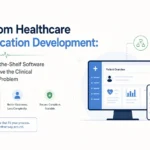
Custom healthcare application developments is the right answer when off-the-shelf software forces clinical workflows to adapt to the software rather than the other way around. The wrong answer is building custom when a configurable vendor solution would deliver 90 percent of the value at 30 percent of the cost and risk. Knowing which situation you are in is the first decision this guide addresses.
When Should a Health System Build vs Buy?
The build-vs-buy decision in healthcare is more nuanced than in most industries because the compliance requirements — HIPAA, ONC certification, state regulations, EHR integration standards — apply to both purchased software and custom-built applications. Neither path avoids the compliance work; it just determines who does it.
Build makes sense in three situations: when the workflow is so specific to the organization’s care model that no vendor has addressed it; when the organization has tried vendor solutions and found that the configuration constraints create clinical risk or unacceptable friction; and when the application needs to integrate with internal systems in ways that no off-the-shelf product supports.
Buy makes sense when a vendor solution exists that addresses the core use case, the configuration required to match the organization’s workflow is reasonable, the vendor’s compliance posture is established, and the vendor’s development roadmap aligns with where the organization needs to go. The mistake is customizing a purchased product so heavily that it effectively becomes a custom build with a vendor license attached — creating the cost and risk of custom development without the flexibility.
What Are the Most Common Types of Custom Healthcare Applications?
The custom healthcare applications that health systems and healthcare organizations actually build fall into several recurring categories:
- Clinical decision support tools: applications that surface patient-specific recommendations at the point of care, integrated into the EHR clinical workflow through SMART on FHIR or CDS Hooks
- Care coordination platforms: tools that manage patient handoffs, care team communication, and post-discharge follow-up workflows that the EHR does not handle well across organizational boundaries
- Patient-facing mobile applications: apps that provide patients with appointment management, care plan access, medication reminders, and secure messaging with care teams
- Operational workflow tools: applications that manage scheduling optimization, capacity management, supply chain processes, or staffing workflows specific to the organization’s operational model
- Data integration and reporting applications: custom ETL pipelines, dashboards, and reporting tools that aggregate data from multiple clinical and administrative systems for specific analytical use cases
What Compliance Requirements Apply to Custom Healthcare Application Development?
HIPAA Technical Safeguards for Custom Applications
Any custom application that creates, receives, maintains, or transmits electronic protected health information (ePHI) is subject to HIPAA Security Rule technical safeguard requirements. These include access controls (unique user authentication, automatic logoff), audit controls (logging all ePHI access and modification), integrity controls (mechanisms to confirm ePHI has not been altered in transit), and transmission security (encryption for ePHI transmitted over open networks).
These requirements must be built into the application architecture from the start, not added as a retrofit after development is complete. Retrofitting HIPAA technical safeguards into a completed application is significantly more expensive than incorporating them into the initial design, and the retrofit frequently introduces vulnerabilities that were not present in the original build.
ONC Certification Requirements for EHR-Adjacent Applications
Applications that perform functions covered by ONC Health IT Certification criteria — clinical decision support, electronic prescribing, clinical documentation — may need ONC certification to be used in a Meaningful Use or promoting interoperability context. This certification requirement should be determined before development begins, because it affects the development standards, testing requirements, and documentation the application must meet.
FHIR API Integration Requirements
Custom applications that integrate with Oracle Health (Cerner), Epic, or other certified EHRs must comply with the EHR’s FHIR API implementation guide and the ONC interoperability regulations that mandate FHIR R4 API access. Building FHIR integration requires understanding both the technical API specification and the specific implementation variations that each EHR vendor has built into their FHIR server.
What Makes Healthcare Application Development Different from Standard Software Development?
Healthcare application development differs from standard software development in four structural ways that any development team needs to understand before the first sprint:
- Compliance is not a feature — it is an architectural constraint that affects every design decision from authentication to data storage to API design
- Clinical workflow expertise is required alongside software engineering expertise — applications built by development teams without clinical domain knowledge consistently create workflow friction that drives non-adoption
- EHR integration is more complex than standard API integration because EHR FHIR implementations have significant variation from the published standard and require testing against each EHR environment specifically
Validation requirements for applications used in clinical decision-making contexts exceed standard QA testing — software used to support clinical decisions must be validated against clinical scenarios that reflect real patient populations and edge cases
How Should a Health System Structure a Custom Healthcare Application Development Project?
eGlobal Healthcare IT’s custom healthcare application development engagements follow a structured process that differs from standard software development in three important ways: compliance architecture is defined before any code is written, clinical workflow validation involves actual end users from the first prototype stage, and EHR integration is tested in the target environment — not just against a sandbox — before user acceptance testing begins.
The four phases that every custom healthcare application project should follow are:
- Discovery and compliance architecture (Weeks 1–6): define the clinical use case in workflow terms, identify all compliance requirements that apply, design the integration architecture with the target EHR, and select the technology stack consistent with those requirements
- Prototype and clinical validation (Weeks 6–14): build a working prototype of the core workflow, validate with clinical end users in a realistic workflow simulation, identify and address workflow friction before full development begins
- Full development and EHR integration (Weeks 14–26): complete development based on validated prototype, build and test EHR integration in the target environment, execute HIPAA technical safeguard validation
- UAT and go-live (Weeks 26–32): clinical UAT with realistic patient scenarios and edge cases, compliance documentation completion, production deployment, and hypercare support
Frequently Asked Questions
How long does custom healthcare application development take?
Simple single-function applications with one EHR integration typically take four to eight months. Complex multi-function applications with multiple integrations and ONC certification requirements typically take twelve to twenty-four months. The compliance and integration scope drives the timeline more than the feature count.
How much does custom healthcare application development cost?
Development cost ranges from $150,000 to $2 million+ depending on complexity, integration scope, and compliance requirements. The most reliable cost estimate comes from a detailed scoping engagement that defines the use case, compliance requirements, and integration architecture before estimation begins.
Do we need to involve our EHR vendor when building a custom application?
For applications that integrate with the EHR through FHIR APIs, you will need access to the EHR’s FHIR sandbox and eventually production API credentials. Epic and Oracle Health both have application partner programs that govern third-party application API access.
Can a custom healthcare application be hosted in the cloud?
Yes, with appropriate HIPAA-compliant cloud infrastructure. AWS, Azure, and Google Cloud all offer HIPAA-eligible services with Business Associate Agreements available. Cloud infrastructure selection should be based on your organization’s existing cloud relationships and data sovereignty requirements.
How is a custom healthcare application different from a SMART on FHIR application?
SMART on FHIR is a framework for building applications that launch from within an EHR context and access EHR data through FHIR APIs. A custom healthcare application may or may not use SMART on FHIR — it depends on whether the application needs to integrate with the EHR clinical workflow or operates as a standalone tool.
eGlobal Healthcare IT builds HIPAA-compliant custom healthcare applications with EHR integration, clinical workflow validation, and compliance documentation. Contact us at info@eglobalhealthcareit.com to scope your development project.