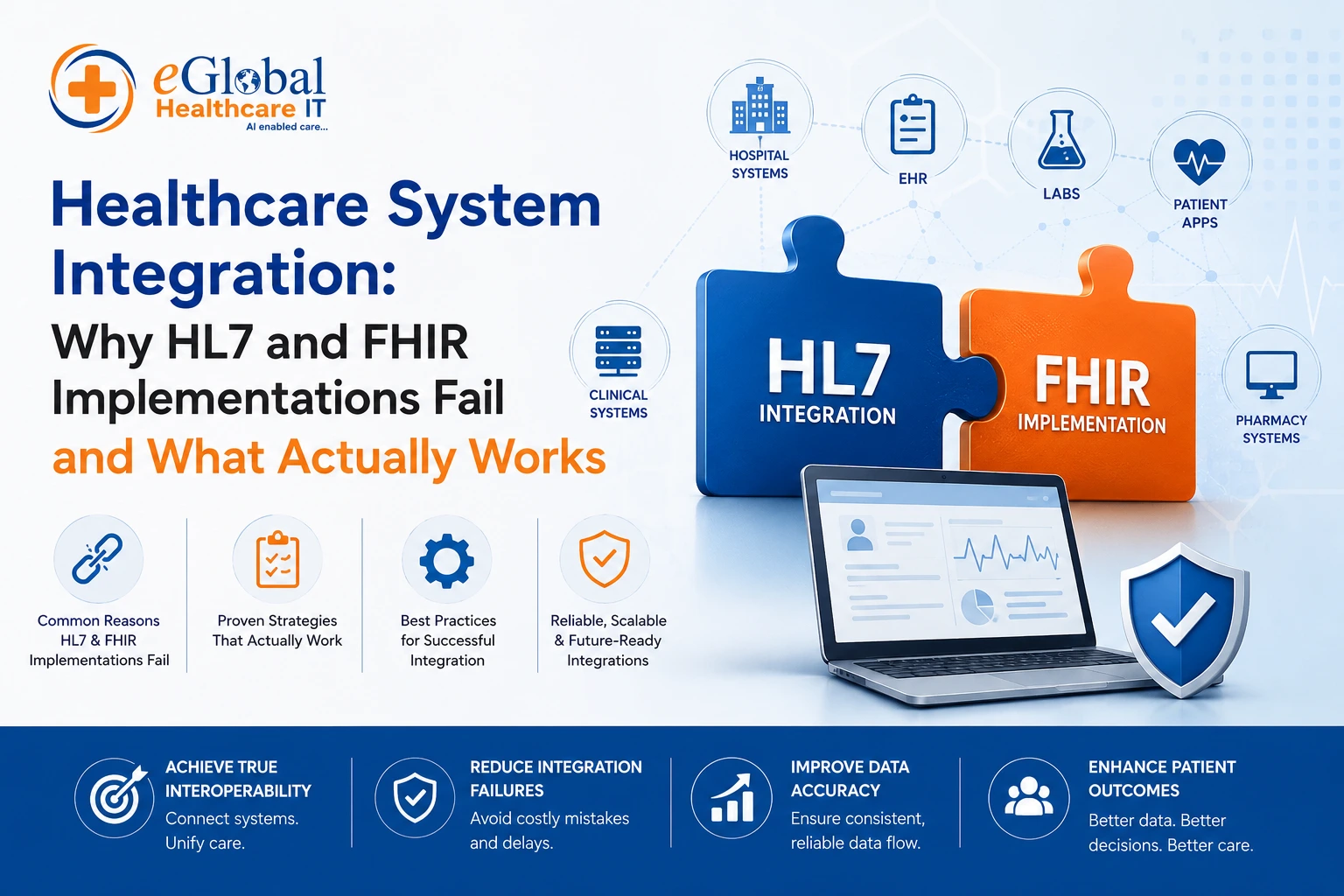
Frame the problem: the average health system runs 60–100+ clinical and administrative applications. Most are partially integrated at best. Data moves between them through a mix of certified interfaces, legacy HL7 pipes built years ago, manual exports, and workarounds nobody documented. When those break, patient care is affected. Position eGlobal as an integration specialist.
What Makes Healthcare Data Migration Different from Standard IT Data Migration?
HL7 v2 Interface Sprawl with No Governance Model
- Hundreds of point-to-point HL7 v2 interfaces with no central registry
- Undocumented interfaces discovered only when they fail
- No testing environment — changes are made in production
FHIR API Implementations Built for Compliance, Not Operability
- Many organizations implemented FHIR APIs to satisfy ONC/CMS interoperability rules without building operational use cases on top of them
- Result: FHIR endpoints exist but are not integrated into clinical workflows
Vendor Interface Specifications That Do Not Match Real Behavior
- Vendor HL7 implementation guides diverge from actual system behavior
- Third-party lab, radiology, and pharmacy systems have non-standard message structures
What Is the Difference Between HL7 v2, HL7 v3, and FHIR — and Which Should Healthcare Organizations Be Building On?
HL7 v2 — Still the Dominant Interface Protocol in Clinical Operations
- Why HL7 v2 is not going away despite being 30+ years old
- Where HL7 v2 remains the right choice (high-volume transactional messaging)
FHIR R4 — The Future of Healthcare Data Exchange
- What FHIR actually changes: RESTful APIs, resource-based data model, JSON/XML
- Use cases where FHIR outperforms HL7 v2: patient-facing apps, payer data exchange, analytics
Protocol | Best Use | Limitations |
HL7 v2 | ADT feeds, lab orders, pharmacy | No standard implementation; brittle |
HL7 v3 / CDA | Clinical document exchange (CCDs) | Complex; largely replaced by FHIR |
FHIR R4 | APIs, app integrations, payer exchange | Requires modern infrastructure |
How Should Health Systems Approach a Clinical System Integration Architecture?
Integration Engine vs Point-to-Point vs API-First Architecture
- When an integration engine (Mirth Connect, Rhapsody, InterSystems HealthShare) is the right model
- When API-first FHIR architecture makes more sense
- When a hybrid approach is appropriate for legacy environments
What an Integration Governance Framework Looks Like
- Central interface registry with documentation and ownership
- Testing environments that mirror production
- Change management processes for interface updates
What Does a Healthcare Integration Project Scope Need to Include?
- Discovery: inventory of all existing interfaces and integration engine configurations
- Current-state assessment: failure rates, monitoring gaps, undocumented interfaces
- Future-state architecture: integration engine consolidation vs FHIR layer vs hybrid
- Build and testing: environment-to-environment testing before production cutover
- Ongoing monitoring and SLA definition
How Are eGlobal Healthcare IT's Integration Services Different from What Most Vendors Offer?
- Certified in HL7 v2, FHIR R4, and CCL/CODE-based integrations within Cerner Millennium
- Experience with Epic’s integration frameworks and Epic-to-third-party interface builds
- Emphasis on documentation, testing environments, and governance — not just interface delivery
Frequently Asked Questions
Is FHIR replacing HL7 v2 for clinical integrations?
No. HL7 v2 remains widely used for clinical messaging, while FHIR is increasingly adopted for modern APIs, interoperability, and patient-facing applications.
What is the difference between an integration engine and a FHIR server?
An integration engine routes and transforms healthcare messages, whereas a FHIR server stores and exposes healthcare data through standardized FHIR APIs.
How do we know which of our current HL7 interfaces are at risk of breaking?
A comprehensive interface assessment can identify outdated mappings, unsupported versions, performance bottlenecks, and compatibility issues before failures occur.
What does healthcare system integration actually cost?
Costs vary based on the number of systems, interface complexity, standards used, and implementation scope, ranging from a few thousand dollars to enterprise-scale investments.
Build Secure, Scalable Healthcare Integrations with Confidence
eGlobal Healthcare IT provides expert healthcare system integration, HL7, and FHIR implementation services, helping organizations design, build, and manage clinical integrations across HL7 v2, FHIR R4, and platform-native protocols. Contact us today to assess your current integration environment.