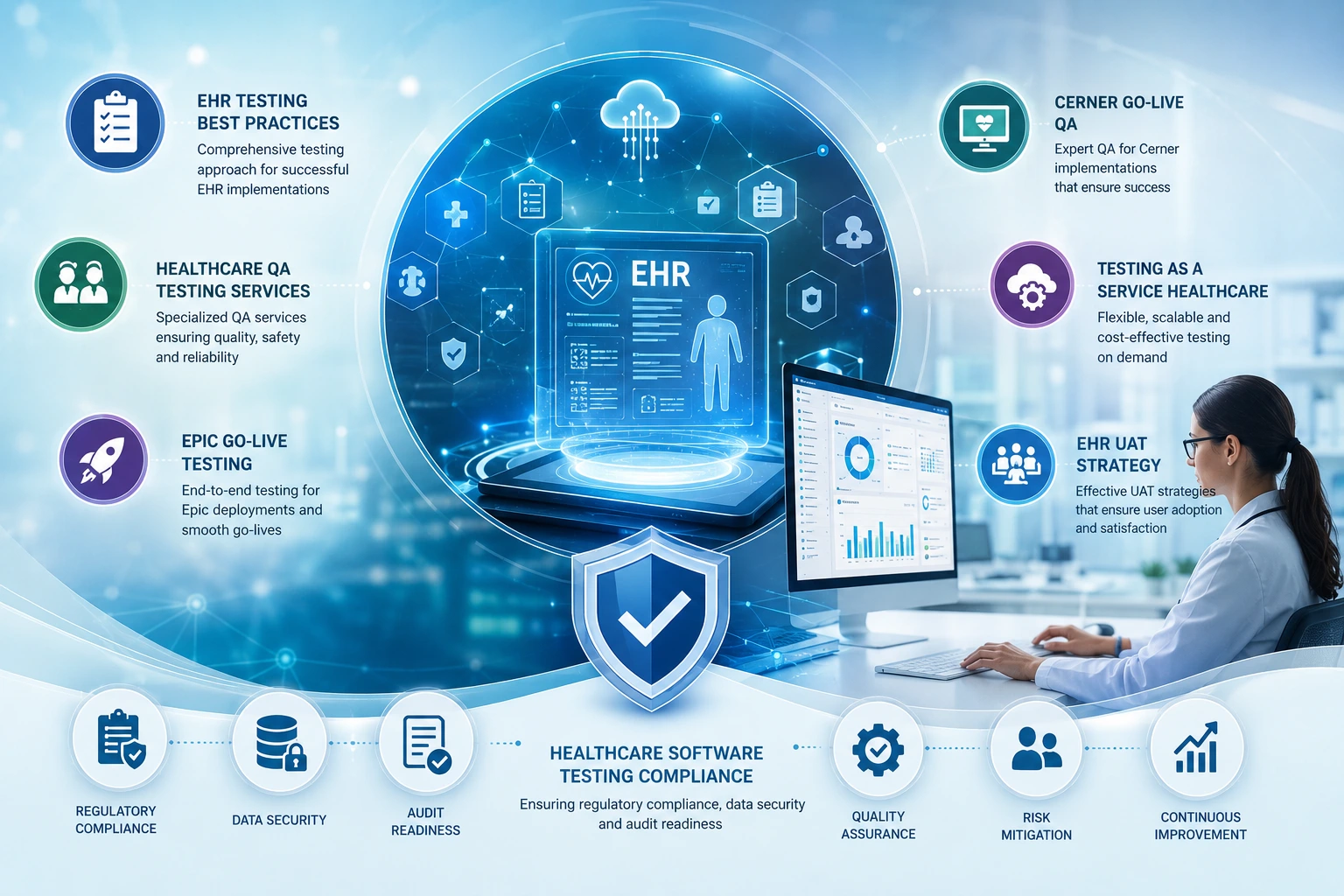
Healthcare EHR go-live testing strategy is one of the biggest determinants of whether an EHR implementation succeeds or struggles after deployment. While many organizations blame technology for go-live issues, most failures stem from inadequate QA planning, insufficient user acceptance testing (UAT), and incomplete regression testing. KLAS Research reports that large healthcare organizations often require 6–12 months of post-go-live stabilization, highlighting the importance of a structured testing strategy from the beginning.
Healthcare EHR Go-Live Testing Strategy: Why Projects Continue to Fail
Healthcare EHR Go-Live Testing Strategy Requires Independent QA
- Testing assigned to the same consultants doing configuration — no independence
- Testing compressed when project timelines slip (it is always the testing phase that gets cut)
UAT Designed for Happy-Path Scenarios Only
- Clinical staff test the workflows they are most familiar with
- Edge cases: exception workflows, downtime procedures, multi-system transactions — not tested
- Interfaces not tested end-to-end with real data volumes
No Regression Testing Plan for Upgrades and Changes
- Post-go-live upgrades and configuration changes untested before production deployment
- Changes made by one team break workflows owned by another team
What Does a Comprehensive EHR Testing Strategy Cover?
Unit Testing, Integration Testing, System Testing, UAT — What Each Actually Means in Healthcare
- Define each testing tier and map it to specific EHR implementation activities
- Common confusion between system testing (IT-led) and UAT (clinical staff-led)
H3: Interface and Integration Testing
- HL7 message testing: ADT, ORM, ORU, MDM message validation
- End-to-end transaction testing: order in Epic → result in LIS → result back in Epic
- Timing and volume testing for high-frequency interfaces
Performance and Load Testing for Clinical Environments
- Response time benchmarks for clinical workflows (order entry, documentation, medication administration)
- Go-live day volume simulation
Testing Type | Who Leads | When in Project | Common Failure Point |
Unit/build testing | Configuration team | Build phase | Not independent |
Integration testing | IT/integration team | Pre-UAT | Incomplete interface coverage |
UAT | Clinical superusers | Pre-go-live | Happy-path only |
Performance testing | IT/testing team | Pre-go-live | Often skipped |
Regression testing | QA team | Post-go-live ongoing | No process in place |
What Is Testing as a Service (TaaS) in Healthcare and When Does It Make Sense?
What TaaS Means in a Healthcare IT Context
- Outsourced, structured testing execution with healthcare domain expertise
- Covers scripted test case development, execution, defect tracking, and reporting
When Healthcare Organizations Should Use TaaS Instead of Internal Testing Resources
- Insufficient internal QA capacity for large implementation or upgrade
- Need for independence between build team and test team
- Ongoing regression testing for post-go-live maintenance
How Does Healthcare QA Testing Differ from Standard Software QA?
- Regulatory context: ONC certification requirements, HIPAA data handling in test environments
- Clinical safety implications of defects — an untested medication administration workflow is not just a UX issue
- Requirement for clinically validated test scripts (written by people who understand the workflow, not just the software)
- Test data management: de-identified patient data for test environments, realistic volume
What Should Healthcare IT Leaders Look for in a Healthcare QA Testing Partner?
- Healthcare domain expertise alongside QA methodology — not generic software testing firms
- Experience testing on the specific EHR platforms in scope (Epic, Cerner Millennium)
- Ability to develop clinically realistic test scripts, not just technical scenarios
- TaaS model that scales with implementation phases and post-go-live cycles
Frequently Asked Questions
How many test cases does a typical Epic or Cerner go-live require?
A typical Epic or Cerner go-live requires 1,500–5,000+ test cases, depending on modules, integrations, and interfaces in scope. Large health systems with multiple specialties and third-party integrations often exceed this range.
Can our internal clinical superusers perform UAT without QA support?
Clinical superusers can validate workflows but typically lack the structured test design, traceability, and defect management skills QA teams provide. Without QA support, critical integration, interface, and edge-case defects often go undetected until production.
What is the cost of inadequate EHR testing compared to a proper QA investment?
Inadequate EHR testing can cost 3–10x more in post-go-live fixes, downtime, and patient safety incidents than a proper QA investment upfront. Industry data shows go-live defects cost significantly more to resolve than issues caught pre-launch.
How do we test Cerner or Epic upgrades without disrupting production?
Use a dedicated non-production (sandbox/test) environment mirroring production to validate upgrades through regression, integration, and interface testing before deployment. A phased rollout with rollback plans further minimizes disruption risk.
EHR Testing & QA Services for Epic and Oracle Health (Cerner) Go-Lives
eGlobal Healthcare IT’s QA specialists design and execute structured testing programs for Epic, Oracle Health (Cerner Millennium), and custom healthcare applications. Contact us to assess your testing readiness before your next go-live.