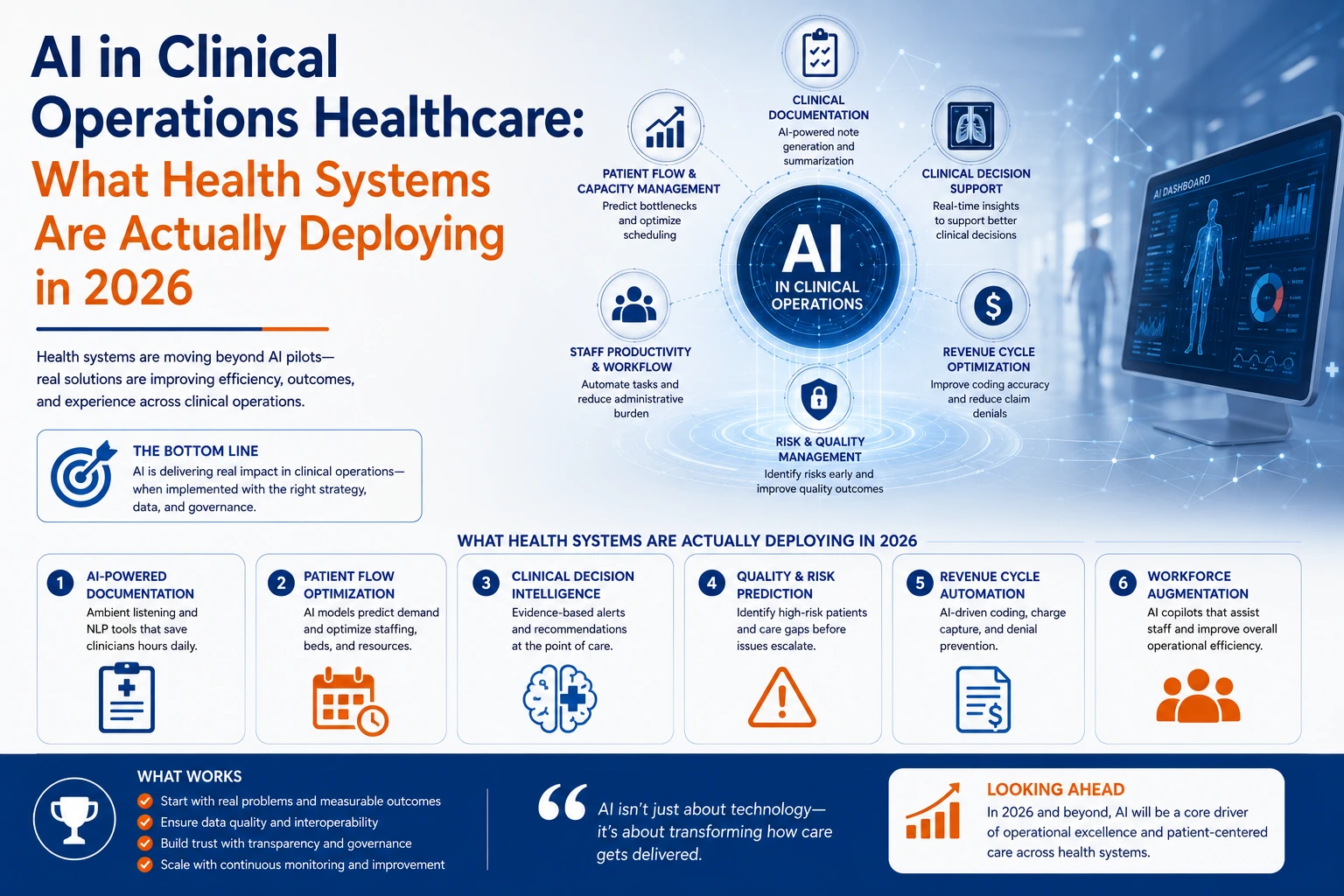
AI in clinical operations healthcare has been positioned as a transformative force for more than a decade. While some health systems are now achieving measurable improvements in clinical workflows, staffing efficiency, and operational performance, many initiatives still fail during implementation rather than because of the underlying technology. This article examines what health systems are actually deploying successfully, where AI adoption is still evolving, and the factors that separate high-ROI implementations from unsuccessful projects.
AI in Clinical Operations Healthcare: Top Applications Deployed by Health Systems
AI in Clinical Operations Healthcare for Patient Flow and Capacity Management
- Readmission prediction models (reducing 30-day readmissions)
- ED throughput and bed management prediction
- Surgical case duration prediction for OR scheduling optimization
- Real deployment examples: hospitals using ML-driven models to reduce ED boarding hours
AI in Clinical Operations Healthcare for Clinical Documentation
- Ambient AI scribing (Nuance DAX, competing offerings) and physician time savings
- NLP-based clinical coding and CDI (Clinical Documentation Improvement)
- Limitations: accuracy variation by specialty, EHR integration friction
AI in Clinical Operations Healthcare for Early Warning Systems
- ML models for early sepsis detection and clinical deterioration alerts
- Integration with EHR alert systems (Epic, Cerner)
- Key challenge: alert fatigue — when models are too sensitive, clinical staff stop responding
What AI Use Cases in Healthcare Are Still Underperforming?
Radiology AI Adoption Is Slower Than Expected — Why?
- FDA-cleared radiology AI tools significantly outnumber deployed tools
- Radiologist workflow integration, liability questions, and reimbursement uncertainty
Predictive Models That Perform in Research, Not in Production
- Model drift: AI models trained on historical data degrade as patient populations and care patterns shift
- The difference between a validated model and a clinically deployed model with ongoing monitoring
Why Do Healthcare AI Implementations Fail at the Clinical Adoption Stage?
Clinician Trust and Explainability
- Black-box models that cannot explain their predictions are not adopted by clinicians
- The XAI (explainable AI) requirement in clinical settings
EHR Integration Friction
- AI tools that operate outside the EHR workflow require clinicians to change contexts — they do not get used
- Native EHR integration vs standalone AI application tradeoffs
No Model Governance Framework Post-Deployment
- Who monitors model accuracy after go-live?
- How are model updates validated before production deployment?
- HIPAA and patient safety implications of unmonitored model drift
How Should Health Systems Evaluate and Prioritize AI/ML Use Cases?
|
Evaluation Criteria |
Questions to Ask |
|
Clinical impact |
Does this use case address a measurable patient outcome or operational KPI? |
|
EHR integration feasibility |
Can this AI output be surfaced inside existing clinical workflows? |
|
Data availability |
Is the training data available, clean, and compliant? |
|
Explainability requirement |
Will clinicians accept the model’s reasoning? |
|
Ongoing governance |
Who owns model monitoring and retraining? |
What Role Does a Healthcare IT Partner Play in Clinical AI Implementation?
- Custom AI/ML model development vs integration of vendor AI tools
- Data pipeline and analytics infrastructure that AI models require
- EHR integration for surfacing AI insights inside clinical workflows
- eGlobal Healthcare IT’s AI/ML development capabilities — CTA anchor
Frequently Asked Questions
What is AI in clinical operations healthcare?
AI in clinical operations healthcare refers to the use of artificial intelligence to improve hospital operations, patient scheduling, clinical documentation, staffing optimization, and decision support.
How are health systems using AI in clinical operations?
Health systems are deploying AI for documentation, revenue cycle optimization, patient flow management, predictive staffing, and operational analytics.
Why do AI implementations fail in healthcare?
Most failures occur because of poor workflow integration, limited clinician adoption, governance challenges, or low-quality data rather than shortcomings in AI models.
Custom AI/ML Applications for Healthcare, Built for HIPAA Compliance
eGlobal Healthcare IT builds and integrates AI/ML applications for healthcare organizations from custom predictive models to EHR-integrated clinical decision support tools. Contact us to discuss your AI roadmap.