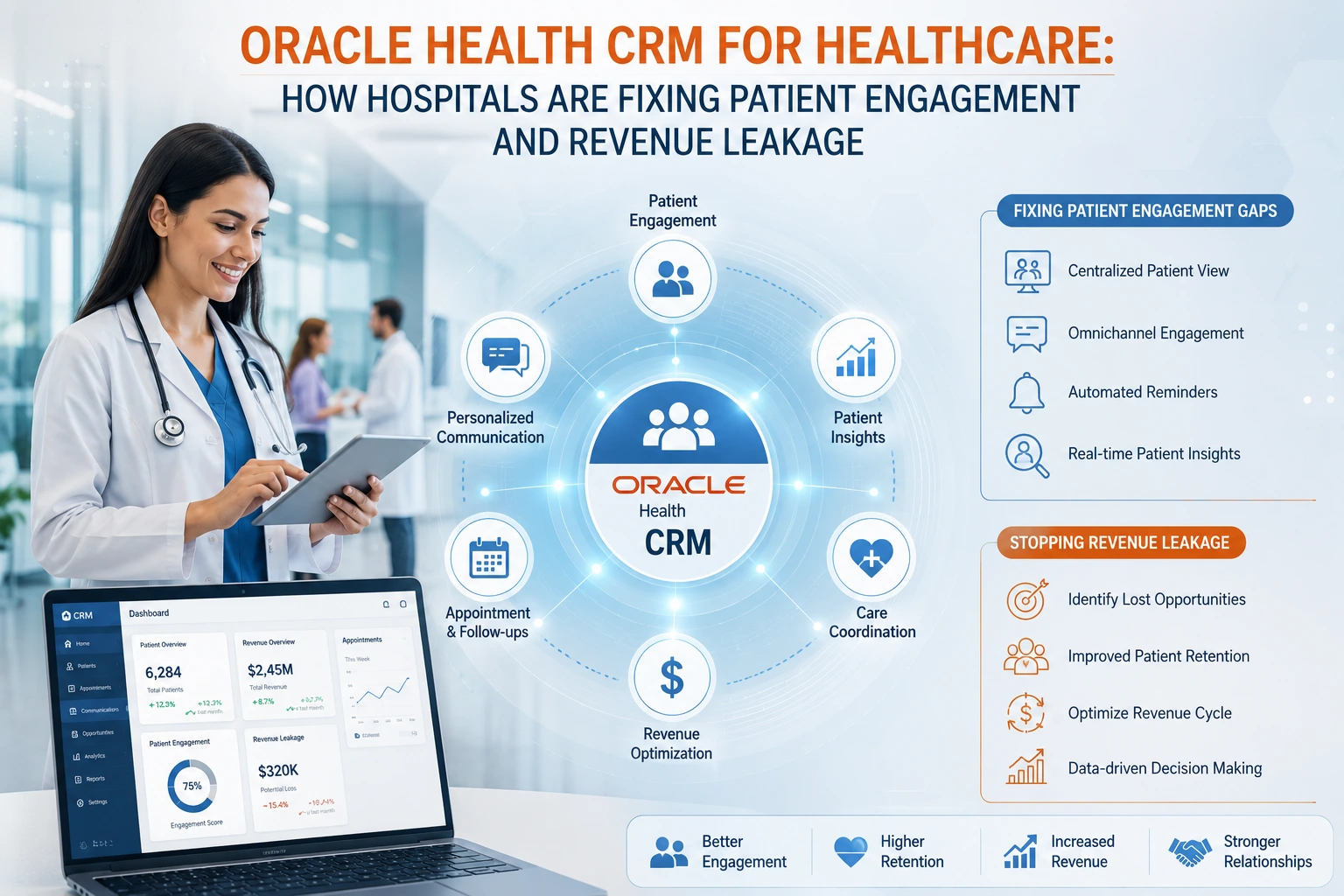
Oracle Health CRM reduces patient leakage and improves outreach ROI when configured correctly for health system workflows. Most hospitals implementing a healthcare CRM for the first time underestimate the data integration requirements. This guide covers what Oracle Health CRM actually delivers and what implementation gets wrong.
Why Are Health Systems Investing in CRM Now?
Patient leakage when patients leave a health system for care that could have been provided internally costs the average large health system $97 million per year according to research from Sg2. Most of that leakage is preventable, not through clinical changes, but through communication failures: patients who did not know the service was available, referrals that were not followed up, post-discharge touchpoints that never happened.
Healthcare CRM is the infrastructure that makes systematic patient communication possible at scale. It connects patient data from the EHR, identifies care gaps and outreach opportunities, and automates the communication workflows that keep patients engaged with the health system between visits. Oracle Health CRM is purpose-built for this use case, designed to work natively with Oracle Health (Cerner Millennium) clinical data rather than requiring a complex integration layer to access patient records.
How Oracle Health CRM Differs from Generic CRM Platforms
Salesforce Health Cloud and Microsoft Dynamics 365 for Healthcare are both capable platforms, but they were built as horizontal CRM tools adapted for healthcare. Oracle Health CRM was built for healthcare from the ground up, with native access to Cerner Millennium patient data, care team workflows, and clinical event triggers. For health systems already running Oracle Health as their primary EHR, the CRM implementation timeline is shorter and the integration complexity is significantly lower than deploying a third-party CRM alongside Cerner.
The practical difference shows up in campaign triggers. In Oracle Health CRM, a discharge event in Cerner automatically triggers a post-discharge outreach sequence without requiring a middleware integration to detect the event. A care gap identified in the clinical record automatically populates a preventive care outreach list. These native event triggers are the core differentiator for Oracle Health CRM in Cerner-primary environments.
What Does Oracle Health CRM Actually Do for a Health System?
Oracle Health CRM covers four primary use cases that health system marketing and patient access teams deploy it for:
- Patient acquisition and referral management: tracking referral sources, identifying referring physician relationships that need strengthening, and managing outreach to physicians whose referral volumes have declined
- Patient retention and care gap outreach: identifying patients overdue for screenings, follow-up appointments, or chronic disease management visits and automating personalized outreach through email, SMS, and direct mail
- Post-discharge and care transition management: automating follow-up communication after inpatient or outpatient episodes to reduce avoidable readmissions and improve patient satisfaction scores
- Service line marketing: targeted outreach to patient populations for high-margin service lines — orthopedics, cardiovascular, oncology — based on clinical and demographic data
The common thread across all four use cases is data. Oracle Health CRM is only as effective as the patient data flowing into it. Organizations that implement CRM without first addressing EHR data quality, patient matching accuracy, and consent management consistently find their outreach lists are too dirty to be actionable.
What Are the Most Common Oracle Health CRM Implementation Failures?
Implementing CRM Before Addressing EHR Data Quality
Oracle Health CRM pulls patient demographics, diagnosis codes, visit history, and care gap data from Cerner Millennium. If the Cerner patient master has duplicate patient records, inconsistent problem list documentation, or incomplete demographic data, those problems flow directly into CRM campaign lists. A preventive care outreach campaign built on a dirty patient list produces low response rates, patient complaints about irrelevant messaging, and compliance exposure if outreach reaches patients who have opted out.
Before CRM implementation begins, a patient data audit covering duplicate patient rates, demographic completeness, and care gap documentation accuracy should be completed. In most health systems this audit reveals data quality issues that need remediation before CRM can deliver its projected value.
Underestimating the Consent and Compliance Configuration
Healthcare CRM outreach is subject to HIPAA, TCPA for SMS and phone outreach, and state-specific patient communication regulations. Oracle Health CRM has consent management capabilities built in, but they require explicit configuration: which outreach channels require explicit opt-in, how opt-out requests are processed and propagated, how marketing communications are distinguished from treatment-related communications under HIPAA. Organizations that configure CRM campaigns without a compliance review of the consent management setup create legal exposure that surfaces when a patient complaint triggers a regulatory inquiry.
No Integration with the Scheduling and Access Center
Oracle Health CRM generates outreach and identifies patients who need appointments but if there is no integration between CRM and the scheduling system, the campaign is incomplete. A patient who responds to a preventive care outreach message and calls to schedule encounters a call center that has no visibility into why the patient is calling or which provider they should be scheduled with. That friction reduces conversion rates and undermines the ROI case for CRM investment.
How Should a Health System Implement Oracle Health CRM?
Phase | Timeline | Key Activities |
Discovery and data audit | Weeks 1–6 | EHR data quality assessment, consent framework design, use case prioritization, integration mapping |
Configuration and integration | Weeks 6–18 | Campaign configuration, Cerner integration setup, consent management build, scheduling integration |
Testing and compliance review | Weeks 18–22 | End-to-end campaign testing, compliance review, opt-out workflow validation |
Go-live and optimization | Weeks 22–28 | Initial campaign launch, response rate monitoring, list quality refinement |
What ROI Should Health Systems Expect from Oracle Health CRM?
Three metrics determine whether a healthcare CRM implementation is delivering measurable value within the first year. Patient leakage reduction — the percentage of patients who leave the health system for services available internally — should show a measurable decline within two to three quarters of active outreach campaigns. Appointment conversion rate from outreach campaigns — the percentage of patients receiving a care gap message who schedule an appointment — should be tracked by service line and campaign type. Readmission rate for targeted post-discharge cohorts should show improvement compared to the pre-CRM baseline for the same diagnostic groups.
Health systems that set these three baselines before CRM go-live and track them monthly are able to demonstrate ROI to leadership within the first year. Systems that implement CRM without baseline metrics consistently struggle to defend the investment when budget cycles come around.
Frequently Asked Questions
Can Oracle Health CRM work with Epic EHR instead of Cerner?
Oracle Health CRM is optimized for Cerner Millennium environments. Epic-primary organizations typically evaluate Epic’s native CRM capabilities or third-party platforms like Salesforce Health Cloud, which has stronger Epic integration support than Oracle Health CRM.
What is the difference between Oracle Health CRM and a general CRM like Salesforce?
Oracle Health CRM has native integration with Cerner Millennium clinical data and is purpose-built for healthcare patient engagement workflows. Salesforce Health Cloud is a horizontal CRM platform adapted for healthcare that requires more integration work in Cerner environments but offers broader third-party ecosystem options.
How long does Oracle Health CRM implementation take?
For a mid-size health system with moderate use case scope, expect five to seven months from project start to first campaign launch. Data quality remediation in the EHR is the most common factor that extends that timeline.
Does Oracle Health CRM require a separate HIPAA Business Associate Agreement?
Yes. Any system that processes or accesses PHI for marketing or outreach purposes requires a BAA. Oracle Health CRM BAA terms should be reviewed with your compliance and legal team before implementation begins.
How does Oracle Health CRM handle patient opt-out requests?
Oracle Health CRM has consent management capabilities that propagate opt-out requests across outreach channels. The configuration of opt-out workflows must be reviewed by your compliance team to confirm alignment with HIPAA and TCPA requirements for your specific outreach types.
eGlobal Healthcare IT implements and optimizes Oracle Health CRM for health systems running Cerner Millennium. Contact us at info@eglobalhealthcareit.com to schedule a CRM readiness assessment.