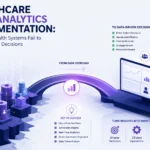
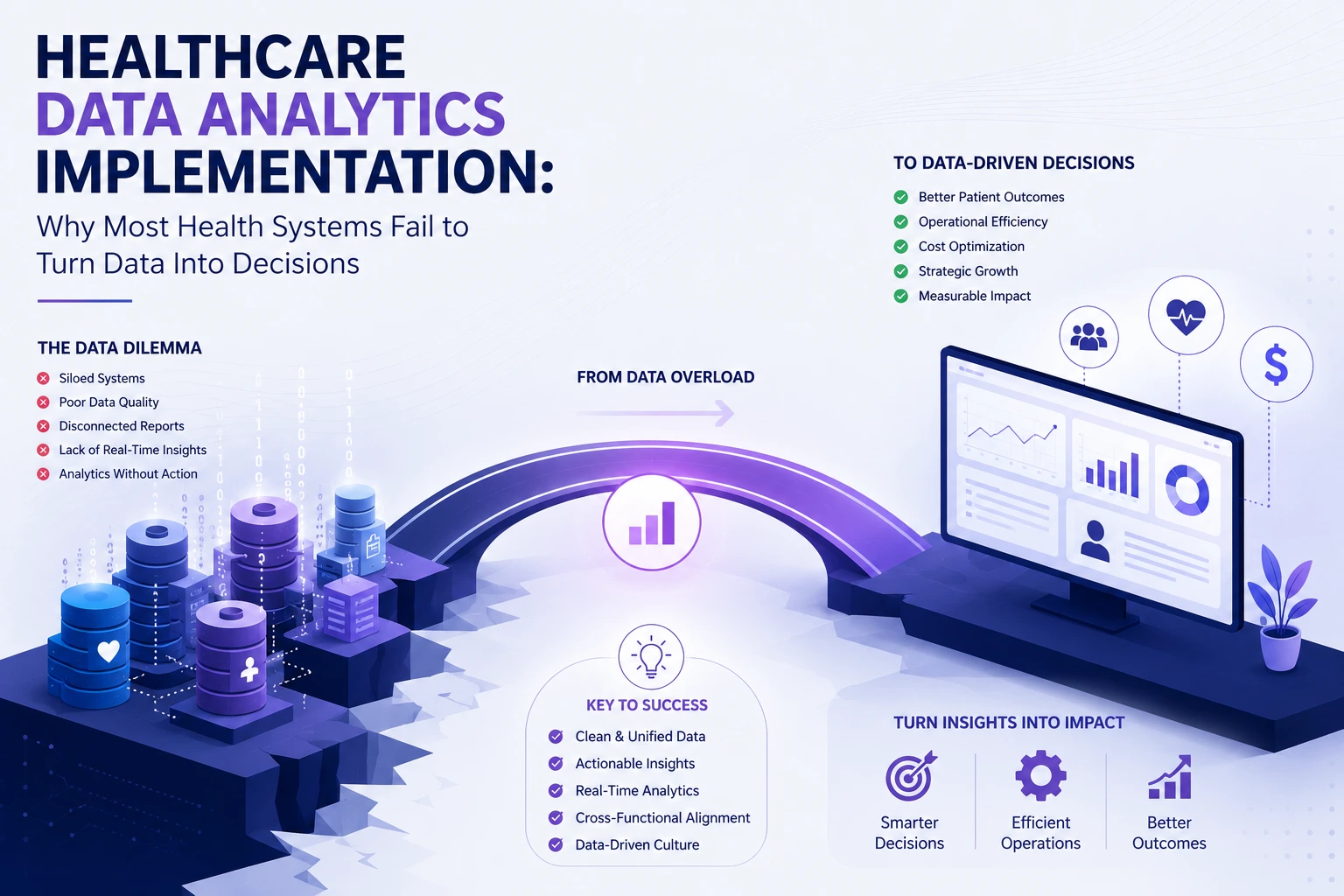
Healthcare data analytics implementation fails most often because the data infrastructure problem and the use case problem are treated as the same project. They are not. Most health systems have more data than they can analyze and fewer defined use cases than they realize. Separating these two workstreams is the first step toward analytics that actually influence clinical and operational decisions.
Why Is Healthcare Data Analytics So Difficult to Get Right?
Every healthcare analytics implementation involves three distinct problems that require different technical and organizational solutions:
- Data infrastructure: building the pipelines that move clinical, operational, and financial data from source systems into an analytically accessible environment with acceptable latency and data quality
- Data governance: establishing the rules, ownership, and processes that determine whose data definitions are authoritative, how data quality issues are identified and resolved, and how access to sensitive data is controlled
- Analytics consumption: making analytical findings accessible and actionable for the clinical, operational, and financial decision-makers who need to act on them — not just for the data team that produces them
Most healthcare analytics projects focus heavily on the first layer and underinvest in the second and third. The result is sophisticated data infrastructure that produces dashboards nobody looks at because the data definitions are disputed, the metrics do not match what leaders actually need to make decisions, and the reports require a data analyst to interpret before anyone can act on them.
What Are the Most Common Healthcare Data Analytics Implementation Failures?
Starting with the Technology Instead of the Use Case
Purchasing a BI platform — Tableau, Power BI, Oracle Analytics Cloud — before defining the specific clinical and operational questions the analytics program needs to answer is the most common and most expensive implementation mistake. The technology decision should follow the use case definition, not precede it. Different use cases require different data architectures, different latency requirements, and different end-user interfaces. A technology chosen without defined use cases will inevitably be misconfigured for the actual questions leadership wants answered.
EHR Data Quality That Makes Analytics Unreliable
The quality of analytics output is bounded by the quality of the EHR data feeding it. In most health systems, clinical documentation quality varies significantly by department, provider, and documentation workflow. Problem list maintenance is inconsistent. Diagnosis codes are sometimes assigned for billing accuracy rather than clinical accuracy. Nursing documentation follows different patterns across units. These inconsistencies, which are manageable in clinical operations, become analytical noise that makes population-level reporting unreliable.
Healthcare data analytics implementation must include a data quality assessment phase that identifies the specific EHR documentation patterns that will affect each planned use case. Some use cases — ED throughput analysis, OR utilization reporting — are relatively insensitive to clinical documentation quality. Others — population health gap analysis, chronic disease management reporting — depend on documentation accuracy that many health systems do not currently achieve consistently.
No Data Governance Framework Before Analytics Deployment
When analytics results are disputed — and they will be, because different stakeholders will have different expectations about what the numbers should show — the dispute resolution process depends on having authoritative data definitions. What counts as a readmission? Which encounters are included in the ED visit volume count? How is length of stay calculated for transfers? Without documented, approved data definitions, every disputed report becomes a negotiation rather than a resolution.
What Healthcare Analytics Use Cases Deliver the Fastest ROI?
Use Case | Data Sources Required | Typical Time to Value |
OR utilization and block schedule optimization | EHR scheduling, case duration, room turnover | 3–6 months |
ED throughput and boarding time reduction | EHR ADT, triage, disposition data | 3–6 months |
Readmission risk identification | EHR discharge data, diagnosis codes, social determinants | 6–9 months |
Preventive care gap identification | EHR problem list, order history, care protocols | 6–12 months |
Population health management | EHR, claims, lab, pharmacy data | 9–18 months |
Physician productivity and RVU reporting | EHR clinical documentation, billing data | 4–8 months |
How Should a Health System Structure a Healthcare Data Analytics Program?
A phased approach that separates infrastructure from use case delivery produces faster time-to-value and lower project risk than attempting a comprehensive analytics platform build before any use cases go live.
- Phase 1 — Foundation (Months 1–4): data warehouse architecture design, EHR data extract pipeline build for two to three priority use cases, data governance framework and data dictionary for initial use cases
- Phase 2 — First Use Cases (Months 4–9): build and validate two to three high-priority dashboards, establish data stewardship process, train analytics consumers on interpreting and acting on output
- Phase 3 — Expansion (Months 9–18): add additional use cases based on Phase 2 learnings, expand data sources (claims, lab, pharmacy), build predictive model infrastructure for risk stratification use cases
How Does Oracle Health Analytics Fit Into This Architecture?
Oracle Health (Cerner) includes built-in analytical capabilities through its CareAware and Cerner Command Center tools, which provide operational and clinical dashboards within the Cerner environment. These native tools are useful for departmental operational monitoring but are limited for organization-wide strategic analytics and cross-system reporting.
Most health systems running Oracle Health supplement native analytics with a separate data warehouse and BI platform that aggregates EHR data alongside financial, operational, and external data sources. eGlobal Healthcare IT’s data analytics and integration services include both the data pipeline architecture and the BI platform configuration — building the complete data-to-decision pathway rather than just the technical infrastructure.
Frequently Asked Questions
What analytics platform works best with Oracle Health (Cerner)?
Oracle Analytics Cloud integrates natively with Oracle Health data. Power BI and Tableau are also widely used alongside Cerner in health systems that have existing Microsoft or Salesforce relationships. Platform selection should follow use case definition, not precede it.
How long does it take to build a healthcare data warehouse?
A foundational data warehouse supporting two to three initial use cases typically takes four to eight months to design, build, and validate. More complex environments with multiple EHR instances, claims data, and external data sources take twelve to eighteen months for full scope.
What is the difference between clinical analytics and operational analytics in healthcare?
Clinical analytics focuses on patient outcomes, care quality, and population health. Operational analytics focuses on throughput, resource utilization, staffing, and financial performance. Both draw on EHR data but require different data models and serve different decision-makers.
Can we use our EHR reporting tools instead of building a separate data warehouse?
For departmental operational reporting, EHR native tools are often sufficient. For cross-departmental, multi-system, or strategic analytics, a separate data warehouse is almost always required because EHR systems are not optimized for complex analytical querying across large datasets.
What data governance roles does a health system need for analytics?
At minimum: a data governance committee with clinical, operational, and financial representation; data stewards for each major data domain (clinical, financial, operational); and a data dictionary owner who maintains authoritative definitions for all reported metrics.
eGlobal Healthcare IT builds healthcare data analytics programs from EHR data pipeline through clinical and operational dashboards. Contact us at info@eglobalhealthcareit.com to discuss your analytics requirements.