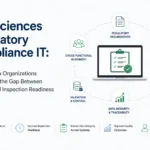
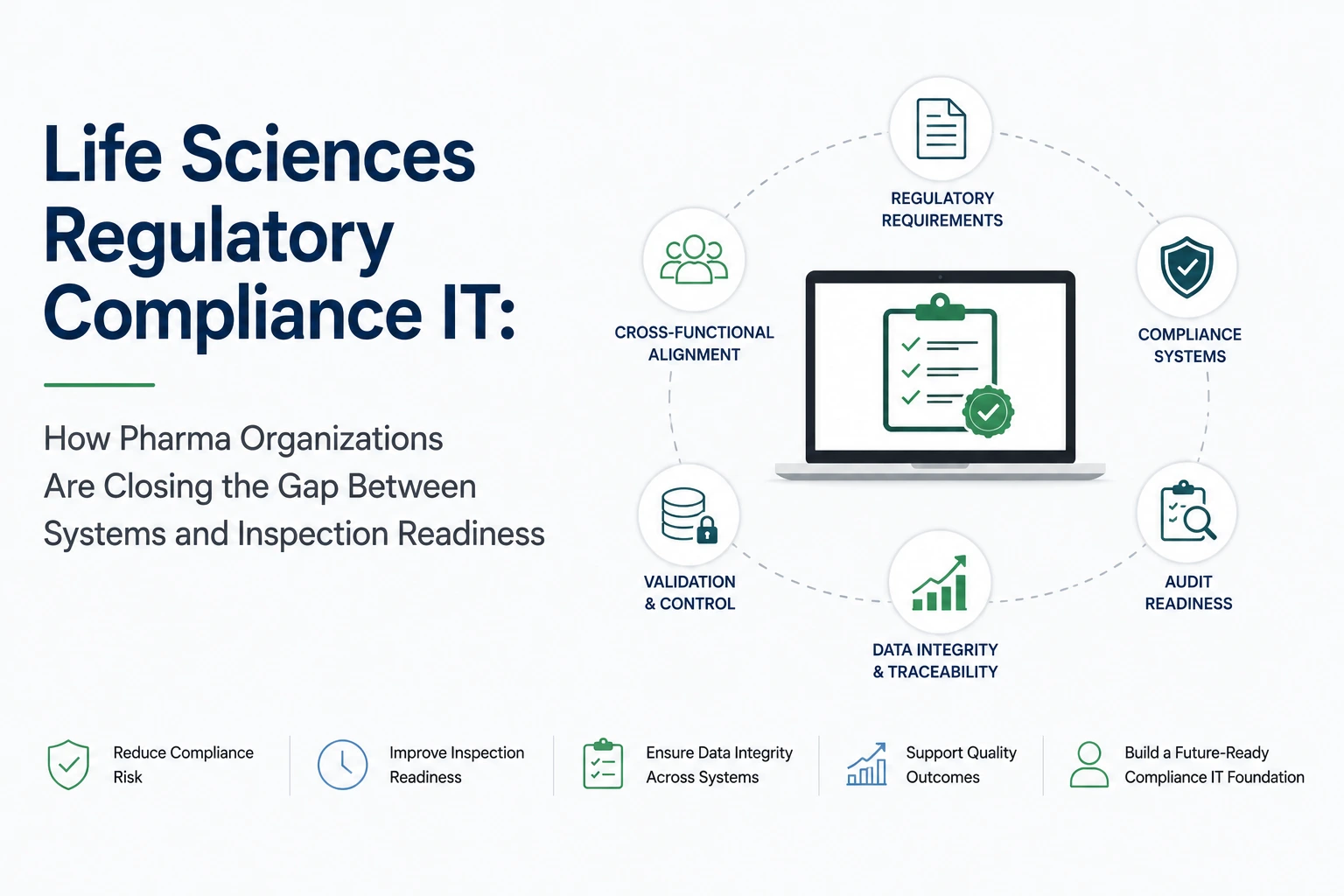
Life sciences regulatory compliance IT failures are not discovered in normal operations. They are discovered during FDA inspections, when an investigator requests audit trail evidence for a document approval or system change and the IT team realizes the evidence does not exist, cannot be retrieved, or does not match what the quality process required. Closing that gap before the inspection is the work this guide addresses.
What Does FDA Inspection Readiness Actually Require from IT Systems?
FDA inspection readiness from an IT perspective means being able to produce, on demand, documented evidence that every GxP-relevant IT system was implemented correctly, is operating as validated, has been changed only through documented and approved change control processes, and has audit trails that are complete, accurate, and available for the inspection period being reviewed.
This sounds straightforward. In practice, most pharma and biotech organizations have accumulated IT compliance gaps over years of system additions, configuration changes, and organizational change that left compliance documentation incomplete. Systems implemented before formal CSV procedures were established. Configuration changes made informally without change control. Audit trails that were not reviewed periodically to confirm they were operating correctly. Validation documentation that was completed for initial go-live but never updated to reflect system changes.
An FDA inspector who requests evidence for any of these gaps does not accept an explanation that the organization was unaware of the requirement. The consequence is a 483 observation, and in serious cases a Warning Letter, that requires a formal corrective action program and follow-up inspection. Remediation after a 483 is significantly more expensive and operationally disruptive than proactive compliance program management.
What Are the Most Common IT Compliance Gaps in Life Sciences Organizations?
Validated Systems Operating Beyond Their Validated State
A system is validated at a point in time — the go-live validation documented what the system did when validation was completed. Every configuration change, software update, or infrastructure change after that point potentially moves the system outside its validated state. If those changes were not assessed against the validation baseline, documented in a change control record, and tested before implementation, the system’s validated state cannot be demonstrated to an inspector.
Most life sciences organizations have validated systems that have received dozens or hundreds of changes since initial validation without complete change control documentation. The extent of this gap is usually discovered either during pre-inspection audit preparation or after an inspector identifies it — neither of which is an ideal time to discover the scope of remediation required.
Audit Trail Gaps and Integrity Issues
21 CFR Part 11 requires that audit trails for GxP systems be computer-generated, date and time-stamped, and capture original and changed entries for any record subject to the regulation. Audit trail gaps — periods where the audit trail was disabled, events that were not captured, or audit trail records that were deleted or modified — are a serious inspection finding regardless of whether the underlying data was affected.
The most common audit trail issues in pharma IT environments are: systems where audit trail functionality was not enabled at go-live; systems where software updates inadvertently disabled audit trail capture; and systems where audit trail storage was not sized adequately, causing older records to be overwritten before they were archived.
Access Control and User Management That Does Not Match SOPs
Quality SOPs define who is authorized to perform specific actions in GxP systems — initiating deviation reports, approving batch records, releasing finished products. When the user permissions configured in the system allow users to perform actions they are not authorized to perform under the SOP, the system’s access controls cannot demonstrate compliance with the documented process.
This gap most commonly develops over time as personnel changes — new hires, transfers, departures — are not consistently reflected in system access. An employee who transferred departments two years ago may still have access permissions appropriate to their former role. A departed employee’s account may still be active. These are routine access management failures that become compliance findings when an inspector reviews system user lists against current personnel records and SOPs.
What IT Compliance Requirements Apply to Life Sciences Organizations?
Regulation | Scope | Key IT Requirements |
21 CFR Part 11 | US FDA — electronic records and signatures | Audit trails, electronic signature controls, access controls, system validation |
EU Annex 11 | EMA — computerized systems | System validation, data integrity, backup and recovery, audit trail review |
GAMP 5 | Industry standard for GxP computerized systems | Risk-based validation approach, change control, supplier assessment |
ICH Q10 | Pharmaceutical quality system | Change management, CAPA system, knowledge management IT requirements |
21 CFR Part 820 | FDA — medical device QMS | Design controls, document control system, audit trail for device records |
How Should Pharma IT Teams Build a Proactive Compliance Program?
A proactive life sciences IT compliance program has four components that together prevent inspection findings rather than remediating them after discovery:
- System inventory and validation status tracking: a current record of every GxP system in operation, its validation status, the date of last validation review, and a log of all changes made since initial validation
- Change control process for all GxP systems: a formal process that requires impact assessment, testing, and documentation for every configuration change, software update, or infrastructure change to a validated system before implementation
- Periodic audit trail review: scheduled review of audit trail records for each GxP system to confirm the audit trail is complete, accurate, and capturing the required events — not just assuming it is because it was configured correctly at go-live
Pre-inspection readiness assessment: a structured internal audit conducted six to twelve months before an expected inspection that evaluates compliance status against the regulations applicable to each GxP system and produces a remediation plan for identified gaps
What Does a Life Sciences IT Compliance Remediation Program Look Like?
For organizations that discover significant IT compliance gaps — through internal audit, pre-inspection preparation, or a 483 observation — remediation requires a structured program that eGlobal Healthcare IT’s life sciences and pharma IT solutions team has delivered across pharma and biotech environments. The program has three phases: assessment, remediation, and sustainability.
The assessment phase produces a gap register: every compliance gap identified, its regulatory basis, its risk classification, and an estimated remediation effort. The remediation phase addresses gaps in risk priority order — highest-risk gaps first, with documented evidence produced for each remediation action. The sustainability phase establishes the ongoing change control, audit trail review, and validation maintenance processes that prevent the gaps from recurring.
Organizations that attempt to remediate IT compliance gaps without a structured program — addressing issues reactively as they surface — consistently produce remediation documentation that an inspector views as responsive rather than systematic. A documented, risk-based remediation program produces evidence of organizational commitment to compliance that a reactive approach cannot demonstrate.
Frequently Asked Questions
What is the difference between 21 CFR Part 11 compliance and GxP compliance?
21 CFR Part 11 is the FDA regulation governing electronic records and electronic signatures in FDA-regulated environments. GxP is a broader term covering Good Manufacturing Practice, Good Laboratory Practice, Good Clinical Practice, and other regulated practices. All GxP activities in electronic systems must comply with 21 CFR Part 11; not all 21 CFR Part 11 requirements apply outside GxP activities.
What is computer system validation and who is responsible for it?
Computer system validation is the documented evidence that a GxP computerized system does what it is intended to do consistently and reliably. Responsibility sits with the regulated company, not the software vendor. Even vendor-supplied, cloud-hosted systems require validation documentation produced by or on behalf of the regulated company using the system.
How often should a validated GxP system be revalidated?
Validated systems do not require periodic revalidation on a fixed schedule — they require validation review and update whenever a change is made that could affect the validated state. A system that has not been changed requires no additional validation activity beyond periodic audit trail review and operational monitoring.
What happens if an FDA inspector finds an IT compliance gap?
A compliance gap identified during inspection results in a Form 483 observation. The organization must respond with a formal CAPA (Corrective and Preventive Action) plan within fifteen business days. Depending on the severity and the organization’s response, the FDA may schedule a follow-up inspection to verify CAPA completion.
Can cloud-hosted systems be used for GxP activities in pharma?
Yes, with appropriate validation, supplier assessment, and contractual controls. Cloud-hosted GxP systems require the same validation documentation as on-premises systems, plus supplier qualification documentation confirming the cloud provider’s infrastructure controls meet GxP requirements.
eGlobal Healthcare IT’s life sciences team delivers IT compliance programs, Veeva Vault implementation, and GxP system validation support for pharma and biotech organizations. Contact us at info@eglobalhealthcareit.com to schedule a compliance assessment.