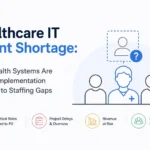
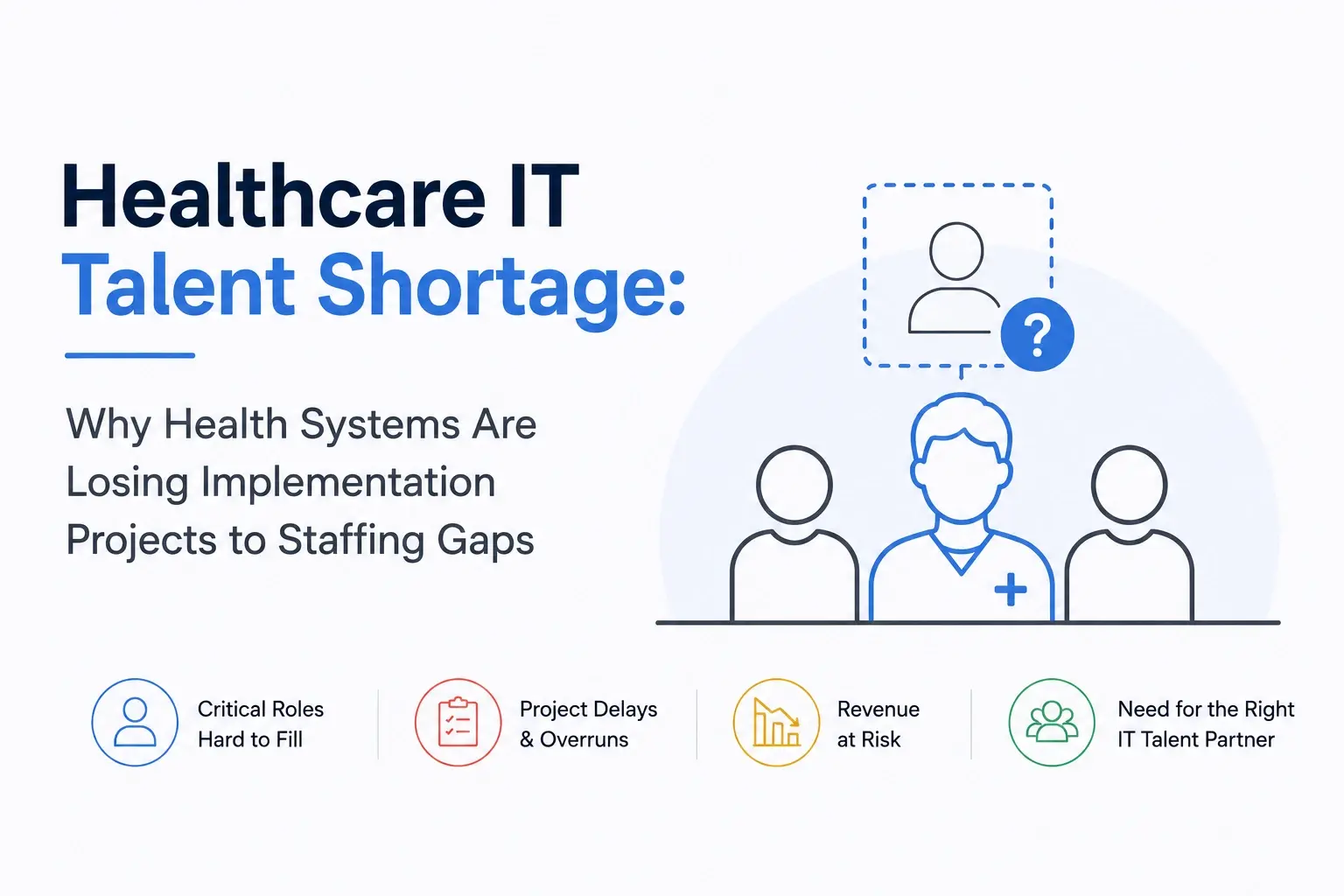
Healthcare IT talent shortages are delaying EHR implementations, stalling go-lives, and forcing health systems to extend contracts with implementation partners long past their original scope. The shortage is structural, not cyclical — the demand for Oracle Health, Epic, and clinical informatics specialists consistently outpaces the supply of credentialed professionals. Here is how health systems are solving it.
How Serious Is the Healthcare IT Talent Shortage?
The healthcare IT workforce shortage is not a short-term market condition — it reflects a structural imbalance between the pace of EHR adoption, platform upgrades, and digital health investment on the demand side, and the supply of professionals with the platform-specific technical and clinical knowledge to support that investment.
Oracle Health (Cerner Millennium) and Epic together account for the majority of large health system EHR installations in the United States. Both platforms require years of hands-on implementation and support experience to develop genuine expertise — and both are undergoing continuous product evolution through cloud migration, AI integration, and interoperability mandates that create demand for updated skills even among experienced practitioners.
The result is a talent market where experienced Oracle Health build analysts, Epic workflow specialists, and clinical informatics professionals command premium rates and can choose among multiple opportunities simultaneously. Health systems competing for this talent against large implementation partners, health IT vendors, and technology consulting firms are at a structural disadvantage in compensation and career development that cannot be resolved through traditional HR approaches alone.
Which Healthcare IT Roles Are Hardest to Fill?
Role | Shortage Severity | Why It Is Hard to Fill |
Oracle Health (Cerner) build analyst | Very High | Requires platform-specific training and hands-on project experience |
Epic certified analyst — clinical modules | Very High | Epic certification is time-gated and non-transferable between organizations |
HL7 / FHIR integration specialist | High | Combination of technical and clinical knowledge is rare |
Healthcare data architect | High | Requires healthcare domain knowledge plus modern data engineering skills |
Clinical informatics director | High | Requires clinical background plus healthcare IT leadership experience |
Healthcare QA / testing analyst | Medium-High | Healthcare-specific testing methodology is not widely taught |
Healthcare project manager (EHR) | Medium-High | EHR implementation PM experience is domain-specific and scarce |
Why Traditional Recruitment Fails for Healthcare IT Roles
Standard recruitment channels — LinkedIn job postings, general-purpose staffing agencies, internal HR — consistently underperform for specialized healthcare IT roles for three structural reasons.
First, the candidates with the skills health systems need are not actively job searching. Experienced Oracle Health and Epic analysts are fully employed, often on multi-year implementation projects, and are approached through professional networks and platform-specific communities rather than job boards.
Second, assessing candidate quality for healthcare IT roles requires domain knowledge that general HR teams and most staffing agencies do not have. A candidate who lists Cerner Millennium experience on a resume may have configuration experience on one module from a single project — or may have led multiple end-to-end implementation programs. The difference in capability is enormous and invisible to a non-specialist hiring process.
Third, the timeline for standard recruitment — posting, screening, interviewing, offering, notice period — typically runs twelve to sixteen weeks. Healthcare IT implementation projects do not wait sixteen weeks for a resource gap to be filled. Project timelines slip, go-live dates move, and contract overruns accumulate while the hiring process follows its standard timeline.
How Are Health Systems Actually Solving the Healthcare IT Talent Problem?
Specialist Healthcare IT Staffing Partners
Health systems that consistently staff healthcare IT projects successfully maintain relationships with specialist staffing partners who maintain active talent networks in Oracle Health, Epic, and clinical informatics communities. These partners can present qualified candidates in two to four weeks rather than twelve to sixteen, because the talent relationships exist before the need arises.
eGlobal Healthcare IT’s healthcare talent services are built on active consultant networks across Oracle Health Cerner, Epic, HL7/FHIR integration, healthcare data engineering, and clinical informatics. The difference between a generalist staffing agency and a specialist healthcare IT partner is the ability to assess a candidate’s actual platform expertise — not just their resume — before presenting them to the health system.
Embedded Consulting with Knowledge Transfer
For health systems that need both immediate capacity and long-term internal capability building, embedded consulting arrangements — where specialist consultants work alongside and train internal staff — produce better outcomes than pure staff augmentation. The internal team builds platform-specific knowledge while the project moves forward, reducing the long-term staffing dependency on external resources.
Managed Services for Ongoing Support Roles
- For post-go-live support roles — Oracle Health Cerner application analysts, integration support, reporting and analytics — managed services arrangements provide more cost-effective ongoing coverage than trying to hire and retain those specialists permanently. The talent market for experienced post-go-live Cerner and Epic analysts is as competitive as the implementation market, and the utilization pattern (steady-state with periodic peaks around upgrades and plan changes) fits a managed services model better than a full-time employment model.
What Should Health Systems Look for in a Healthcare IT Staffing Partner?
Four criteria separate a genuinely useful healthcare IT staffing partner from a general-purpose agency that happens to have some healthcare IT candidates in its database:
- Platform-specific expertise assessment: the partner can evaluate a candidate’s actual Oracle Health or Epic module experience through a technical screening process, not just verify resume claims
- Active network in healthcare IT communities: the partner has relationships with candidates who are currently employed and not actively job searching — not just a database of people who posted resumes
- Healthcare compliance understanding: the partner screens for HIPAA awareness, healthcare project management methodology, and clinical workflow knowledge alongside technical skills
Reference validation in healthcare IT specifically: the partner can provide references from health system clients for similar roles filled with verifiable project outcomes
Frequently Asked Questions
How long does it take to fill an Oracle Health (Cerner) build analyst position?
Through a specialist healthcare IT staffing partner with active Cerner networks, two to four weeks for qualified candidates. Through standard recruitment channels, twelve to sixteen weeks with variable quality outcomes. The difference is the pre-existing talent network, not the recruitment process.
Can we use a general staffing agency for healthcare IT roles?
General staffing agencies can fill volume roles — help desk, basic project coordination, administrative support. For specialized Oracle Health, Epic, HL7/FHIR, or clinical informatics roles, they consistently produce candidates who meet the resume requirement but not the practical expertise requirement. Specialist healthcare IT partners produce better-matched candidates faster.
What is the difference between contract and permanent staffing for healthcare IT?
Contract staffing is appropriate for project-specific roles (implementation analysts, go-live support, upgrade specialists) where the need has a defined endpoint. Permanent staffing is appropriate for ongoing operational roles (analytics lead, integration architect, clinical informatics director) where institutional knowledge and continuity matter more than short-term flexibility.
How do we retain healthcare IT specialists once we hire them?
Healthcare IT specialists prioritize project variety, learning opportunities, and schedule predictability over compensation alone. Organizations that offer exposure to multiple platforms, support certification maintenance, and provide clear career paths retain healthcare IT professionals better than those competing purely on salary.
Can we staff an entire Oracle Health implementation project through a staffing partner?
Yes, through a staffing partner with sufficient Oracle Health consultant depth. Some health systems staff full implementation teams through specialist partners for time-defined programs. This approach requires the partner to have project management capability alongside analyst staffing, which not all healthcare IT staffing firms provide.
eGlobal Healthcare IT’s talent services team sources Oracle Health, Epic, HL7/FHIR, and clinical informatics specialists for health system implementation and support roles. Contact us at info@eglobalhealthcareit.com to discuss your staffing requirements.